
Why Clean Data Is More Important Than AI in 2026
Artificial Intelligence (AI) is transforming the way businesses operate. From intelligent chatbots and predictive analytics to automated content generation and personalized customer experiences, AI has become a key driver of digital transformation.
As organizations continue investing in AI, many believe that adopting the latest AI tools alone will give them a competitive advantage.
However, there is one critical factor that often determines the success or failure of any AI initiative: data quality.
No matter how advanced an AI system is, it can only produce meaningful and reliable results when it is powered by accurate, complete, and well-structured data.
In 2026, businesses that focus on building clean and reliable data foundations will gain a greater competitive advantage than those simply adopting the newest AI technologies.
AI Is Only as Good as the Data It Receives
One of the biggest misconceptions about AI is that it can automatically fix poor-quality data.
The reality is quite different.
AI learns from the information it receives. If your business data is incomplete, outdated, duplicated, or inconsistent, AI will generate unreliable insights, inaccurate recommendations, and poor business decisions.
Think of AI as a high-performance sports car.
Even the most powerful car cannot perform well with poor-quality fuel.
Similarly, AI cannot perform effectively without high-quality data.
What Is Clean Data?
Clean data refers to information that is:
• Accurate
• Complete
• Consistent
• Up-to-date
• Properly structured
• Free from duplicate records
• Easy to access
• Properly categorized
Clean data allows businesses to make better decisions, automate processes, and confidently use AI-powered solutions.
Common Data Challenges Businesses Face
Many organizations struggle with data quality without realizing its impact.
Some of the most common challenges include:
Duplicate Data
The same customer, supplier, or product may exist multiple times across different systems.
Duplicate records create confusion and reduce reporting accuracy.
Missing Information
Important details such as product specifications, images, pricing, or customer information are often incomplete.
Incomplete data leads to poor AI recommendations and operational inefficiencies.
Inconsistent Data
Different departments may use different naming conventions.
For example:
Laptop
Notebook
Portable Computer
Although they represent the same product category, inconsistent terminology makes analysis and automation much more difficult.
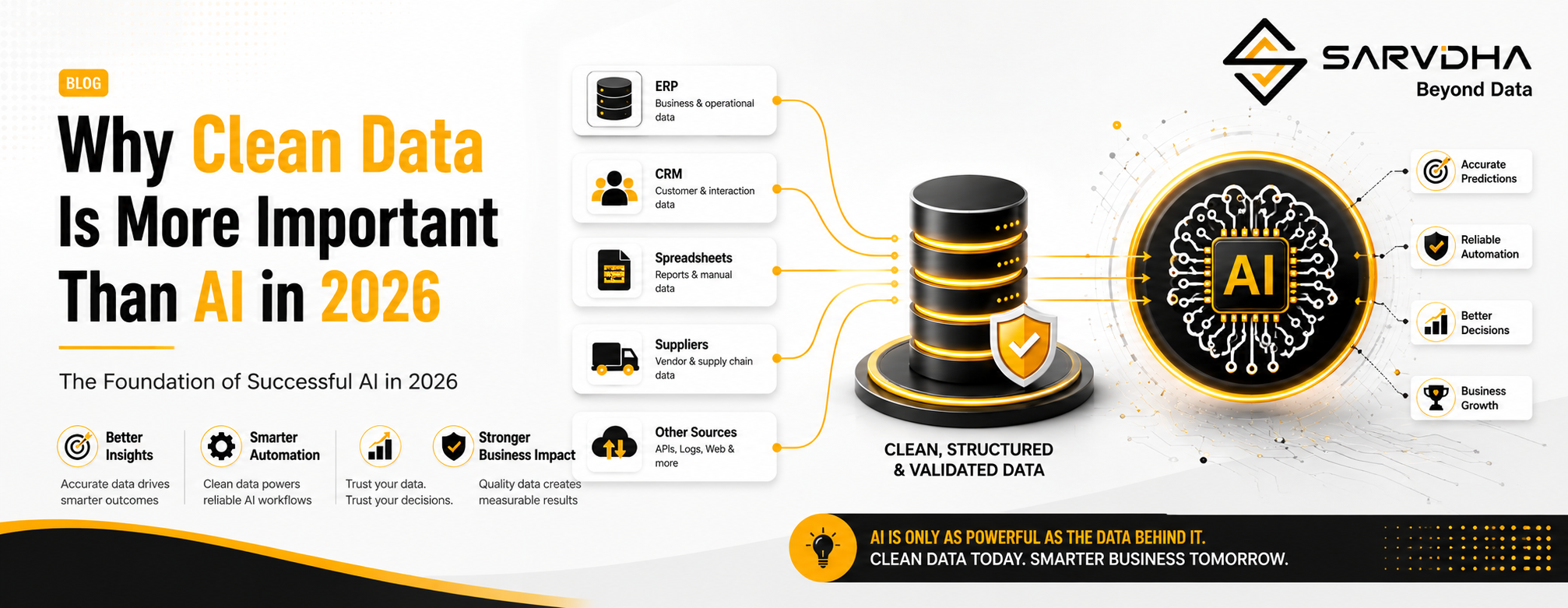
Data Stored Across Multiple Systems
Business information is often spread across:
• ERP systems
• CRM platforms
• Excel spreadsheets
• E-commerce platforms
• Supplier portals
• Internal databases
Without integration, maintaining consistent information becomes extremely challenging.
Why Poor Data Causes AI Projects to Fail
Organizations frequently invest in AI before preparing their data.
As a result, they experience:
• Incorrect predictions
• Low-quality recommendations
• Inaccurate reporting
• Increased manual corrections
• Slow AI adoption
• Lack of trust in AI-generated results
The issue is rarely the AI technology itself.
The real problem is poor data quality.
Structured Data Is the Foundation of AI
AI performs best when data follows a consistent structure.
Instead of scattered spreadsheets and disconnected systems, businesses should organize their information into standardized formats.
For product information, this may include:
• Product Name
• SKU
• Brand
• Category
• Product Attributes
• Technical Specifications
• Images
• Pricing
• Availability
• Related Products
Structured data allows AI systems to understand relationships and deliver more accurate insights.
The Importance of a Single Source of Truth
Modern businesses generate data from multiple departments and systems.
When each department maintains its own version of information, inconsistencies become inevitable.
Creating a Single Source of Truth (SSOT) ensures everyone works with the same trusted information.
Systems that help achieve this include:
• Product Information Management (PIM)
• Master Data Management (MDM)
• Enterprise Resource Planning (ERP)
• Customer Data Platforms (CDP)
A centralized data strategy improves collaboration and creates a stronger foundation for AI.
Preparing Your Business for AI
Before investing in AI, businesses should evaluate their data readiness.
Ask yourself:
✓ Is our data complete?
✓ Is it free from duplicates?
✓ Is it standardized?
✓ Is it consistently maintained?
✓ Can our systems share information?
✓ Do we have clear ownership of our data?
If the answer to several of these questions is "No," your organization should focus on improving data quality before implementing AI initiatives.
The Role of PIM and MDM
Organizations managing large amounts of product or business data benefit from dedicated data management solutions.
A Product Information Management (PIM) system centralizes and enriches product information for multiple sales channels.
A Master Data Management (MDM) solution ensures consistency across core business data such as products, customers, suppliers, and locations.
Together, these solutions provide the trusted data foundation required for successful AI adoption.
AI Is an Accelerator, Not a Replacement
Artificial Intelligence can automate repetitive tasks and improve decision-making.
However, AI cannot replace strong data governance.
Businesses still need processes for:
• Data collection
• Validation
• Standardization
• Maintenance
• Security
• Governance
Organizations that invest in these areas will achieve far better AI outcomes.
Business Benefits of Clean Data
Investing in clean data delivers benefits that extend far beyond AI.
Businesses can expect:
• Better decision-making
• Improved customer experiences
• Faster product launches
• More accurate reporting
• Higher operational efficiency
• Reduced manual work
• Greater trust in analytics
• Better collaboration across departments
Clean data supports long-term business growth and digital transformation.
How Sarvdha Helps Businesses Build an AI-Ready Data Foundation
At Sarvdha, we believe successful AI starts with trusted data.
We help businesses organize, manage, and optimize complex information through services including:
• Product Information Management (PIM)
• Master Data Management (MDM)
• Data Modeling
• Data Integration
• Digital Asset Management (DAM)
• Data Governance
• Custom Software Development
Our goal is to help organizations create structured, scalable, and reliable data that supports both current business operations and future AI initiatives.
Conclusion
Artificial Intelligence will continue reshaping industries in the years ahead.
But AI alone cannot solve poor data quality.
Organizations that invest in clean, structured, and reliable data today will be better positioned to unlock the full potential of AI tomorrow.
Before asking,
"Which AI platform should we implement?"
Businesses should first ask,
"Can we trust our data?"
Because in 2026, clean data is not just a technical requirement—it is a strategic business advantage.
Frequently Asked Questions
What is clean data?
Clean data is accurate, complete, consistent, up-to-date, and free from duplicate or incorrect information.
Why is clean data important for AI?
AI systems rely on the quality of the data they receive. Better data leads to more accurate insights, predictions, and business decisions.
What is a Single Source of Truth?
A Single Source of Truth (SSOT) is a centralized and trusted location where business data is managed and maintained consistently across the organization.
Can AI automatically clean poor-quality data?
AI can assist with identifying inconsistencies and duplicate records, but businesses still need proper data governance and management processes to ensure high-quality data.
How can Sarvdha help?
Sarvdha helps businesses build strong data foundations through Product Information Management (PIM), Master Data Management (MDM), Data Integration, Data Governance, and Custom Software Development, enabling organizations to become truly AI-ready.