
How Global E-commerce Brands Can Scale Product Data Across the US, UK and Europe
Selling online in one country is relatively straightforward.
Selling the same products across multiple countries is a completely different challenge.
A business expanding from the United States into the United Kingdom, Germany, France, or the wider European market quickly discovers that product data cannot simply be copied from one market to another.
Products may require different languages, currencies, measurements, descriptions, attributes, compliance information, images, pricing, and channel-specific content.
The product may be the same.
The product information is not.
This is why global e-commerce businesses need a scalable product data strategy.
A strong Product Information Management (PIM) approach can help organizations centralize product information, manage market-specific variations, maintain data quality, and distribute consistent product content across websites, marketplaces, distributors, and other sales channels.
Why Global E-commerce Is Creating More Product Data Complexity
International e-commerce continues to grow, creating more opportunities for businesses to enter new markets.
In the United States, retail e-commerce sales were estimated at $1.2337 trillion in 2025, accounting for 16.4% of total retail sales.
The UK also continues to show strong online retail activity. In June 2026, online sales represented 29.4% of total retail sales in Great Britain, the highest proportion since April 2021.
Germany's retail market also grew in 2025, with retail sales increasing 2.7% in real terms compared with 2024.
For international brands, this creates a major opportunity.
But it also creates a major data challenge.
The more markets and channels a business enters, the more difficult it becomes to maintain consistent product information.
One Product Can Require Many Versions of Product Information
Imagine an international company selling a smart home device.
The company wants to sell the product in:
🇺🇸 United States
🇬🇧 United Kingdom
🇩🇪 Germany
🇫🇷 France
🇦🇪 United Arab Emirates
The physical product may be almost identical.
However, the information surrounding that product can change.
United States
Currency: USD
Language: English
Measurements: US customary and metric where appropriate
Market-specific product information
United Kingdom
Currency: GBP
Language: English
UK terminology
UK-specific commercial and regulatory requirements
Germany
Currency: EUR
Language: German
European product requirements
Localized descriptions and attributes
UAE
Currency: AED
Localized customer-facing information
Regional product and commercial requirements
The challenge becomes clear:
One product does not necessarily mean one product record.
The Hidden Cost of Managing Global Product Data
Many businesses begin international expansion using spreadsheets and manual processes.
At first, this may appear manageable.
A team might have:
- One spreadsheet for the US
- One spreadsheet for the UK
- One spreadsheet for Germany
- Another spreadsheet for distributors
- Another spreadsheet for marketplaces
Then someone needs to update the product description.
Another person updates the price.
Another person changes the product specifications.
A translation team updates the German content.
The marketplace team updates Amazon.
Suddenly, there are multiple versions of the same product.
This creates a dangerous question:
Which version is correct?
Common Product Data Problems in Global E-commerce
International businesses frequently encounter problems such as:
Duplicate Product Records
The same product may be created multiple times for different countries or channels.
This makes reporting, integration, and maintenance more complicated.
Inconsistent Product Descriptions
The US website may have one description while the German website has another.
The marketplace listing may contain outdated information.
Customers then receive different information depending on where they find the product.
Missing Product Attributes
A product may contain 30 attributes in one market but only 20 in another.
This can make filtering, search, recommendations, and product comparisons less effective.
Translation Problems
Manual translation can create inconsistent terminology.
For example, a technical product attribute may be translated differently by different teams.
Over thousands of products, these inconsistencies become difficult to manage.
Incorrect Currency or Pricing
International businesses often need different prices for different markets.
If pricing is maintained manually, outdated prices can easily reach websites or marketplaces.
Different Measurement Systems
Depending on the product and market, measurements may need to be displayed differently.
Examples include:
- Inches
- Centimeters
- Pounds
- Kilograms
- Fahrenheit
- Celsius
The underlying product data should remain structured while the presentation can adapt to the target market.
Why Excel Stops Scaling
Excel is useful for many business tasks.
It is not a long-term product information architecture.
When a company manages thousands of products across multiple markets, spreadsheets create several problems.
Version Control
Which spreadsheet contains the latest information?
Data Quality
Who checked whether every field is accurate?
Collaboration
Who is allowed to modify the information?
Localization
Which content has already been translated?
Workflow
Who approves changes before publication?
Integration
How does the information reach websites and marketplaces automatically?
At a certain scale, these questions become too complex for spreadsheet-based management.
What a Global Product Data Strategy Should Look Like
A scalable product data strategy should separate core product information from market-specific information.
For example:
Core Product Data
- Product ID
- SKU
- Brand
- Product category
- Technical specifications
- Base images
- Dimensions
- Weight
- Product relationships
Market-Specific Data
- Currency
- Local price
- Market availability
- Local terminology
- Country-specific attributes
- Local compliance information
Language-Specific Content
- Product name
- Description
- Marketing content
- Specifications
- Search keywords
Channel-Specific Content
- Website
- Marketplace
- Distributor
- Mobile application
- Print catalog
This structure makes international expansion much easier to manage.
How PIM Helps Global E-commerce Businesses
A Product Information Management (PIM) platform provides a centralized environment for managing product information.
Instead of maintaining product information separately across multiple systems, businesses can create a controlled product data foundation.
The PIM becomes the central place where product information is created, enriched, validated, approved, and prepared for distribution.
PIM Is More Than a Product Database
A modern PIM strategy should not simply store product information.
It should help businesses manage the complete product information lifecycle.
That can include:
- Product data collection
- Data validation
- Data enrichment
- Taxonomy management
- Attribute management
- Translation workflows
- Approval workflows
- Product relationships
- Digital asset management
- Channel-specific content
- API integrations
- Data syndication
This becomes especially important when businesses operate across multiple countries.
Localization Is More Than Translation
One of the biggest mistakes businesses make is treating localization as simple translation.
Localization can involve much more than changing English text into German or French.
It can include:
- Language
- Currency
- Measurements
- Terminology
- Product attributes
- Search keywords
- Product descriptions
- Images
- Legal information
- Compliance information
- Market-specific availability
For example, translating a product description from English to German does not automatically make the entire product experience suitable for the German market.
The underlying product data must also support the requirements of that market.
Global Product Data and the European Market
European markets introduce another important consideration: increasingly structured and transparent product information.
The European Union's Ecodesign for Sustainable Products Regulation provides a framework for Digital Product Passports (DPPs), which are intended to make relevant product information more accessible throughout a product's lifecycle.
In July 2026, the European Commission launched the Digital Product Passport Registry and testing environment, marking an important step toward making DPP infrastructure operational.
Depending on the applicable product rules, DPP information can include areas such as:
- Product composition
- Durability
- Repairability
- Recyclability
- Environmental information
- Safety information
- Maintenance information
- Spare parts
- End-of-life information
The exact information requirements depend on the relevant product legislation.
For businesses selling into Europe, this creates another reason to think seriously about structured product information.
Product data is increasingly becoming part of the business infrastructure—not simply website content.
The UAE and Global E-commerce
The UAE is also an important market for international e-commerce businesses.
The UAE government describes e-commerce as covering online transactions through websites, mobile applications, social media platforms, and digital marketplaces. Its e-commerce framework also places responsibilities on sellers around accurate product information, consumer protection, data protection, and digital invoicing.
For businesses entering the UAE from the US or Europe, this means product information should be designed to support regional requirements rather than simply copying the content used in another market.
The UAE's broader digital economy strategy also aims to increase the contribution of the digital economy to GDP and strengthen the country's position as a regional and global digital hub.
PIM + AI: The Next Step for Global Commerce
There is another reason structured product data is becoming increasingly important.
Artificial Intelligence.
AI-powered commerce depends heavily on the quality and structure of product information.
Consider an AI shopping assistant.
A customer asks:
"Show me waterproof hiking jackets suitable for cold weather."
To provide a useful answer, the AI needs access to structured information such as:
- Product category
- Material
- Waterproof rating
- Temperature rating
- Size
- Weight
- Color
- Availability
- Customer requirements
If this information is incomplete or inconsistent, the AI may provide poor recommendations.
But when product data is structured and trusted, AI can become much more useful.
This connects directly to the principle from our previous article:
AI is only as good as the data behind it.
How AI Can Help Global Product Data Management
Once the underlying product information is structured, AI can assist with many tasks.
AI-Generated Product Descriptions
AI can create market-specific product descriptions based on approved product attributes.
Automated Translation
AI can assist with multilingual content creation while human review maintains quality.
Product Categorization
AI can help classify products into appropriate categories.
Attribute Extraction
AI can extract structured attributes from supplier documents and product descriptions.
Content Quality Checking
AI can identify missing or inconsistent information.
Semantic Search
AI can help customers find products even when they don't use the exact product terminology.
The important point is that AI should work on top of a trusted data foundation.
Example: A Global Retailer With 20,000 Products
Imagine a retailer with:
20,000 products
Selling in:
🇺🇸 United States
🇬🇧 United Kingdom
🇩🇪 Germany
🇦🇪 UAE
And distributing products through:
- E-commerce website
- Amazon
- Regional marketplaces
- Distributors
- Mobile application
Without a centralized product data strategy, the company may end up maintaining hundreds of thousands of individual pieces of product information.
Now imagine launching a new product.
The team needs to:
- Create the product
- Add technical specifications
- Upload images
- Create descriptions
- Translate content
- Add regional pricing
- Validate the information
- Approve the product
- Publish it to websites
- Publish it to marketplaces
- Update distributor feeds
If much of this process is manual, launching products becomes slow and expensive.
With a well-designed PIM architecture, many of these processes can become standardized and automated.
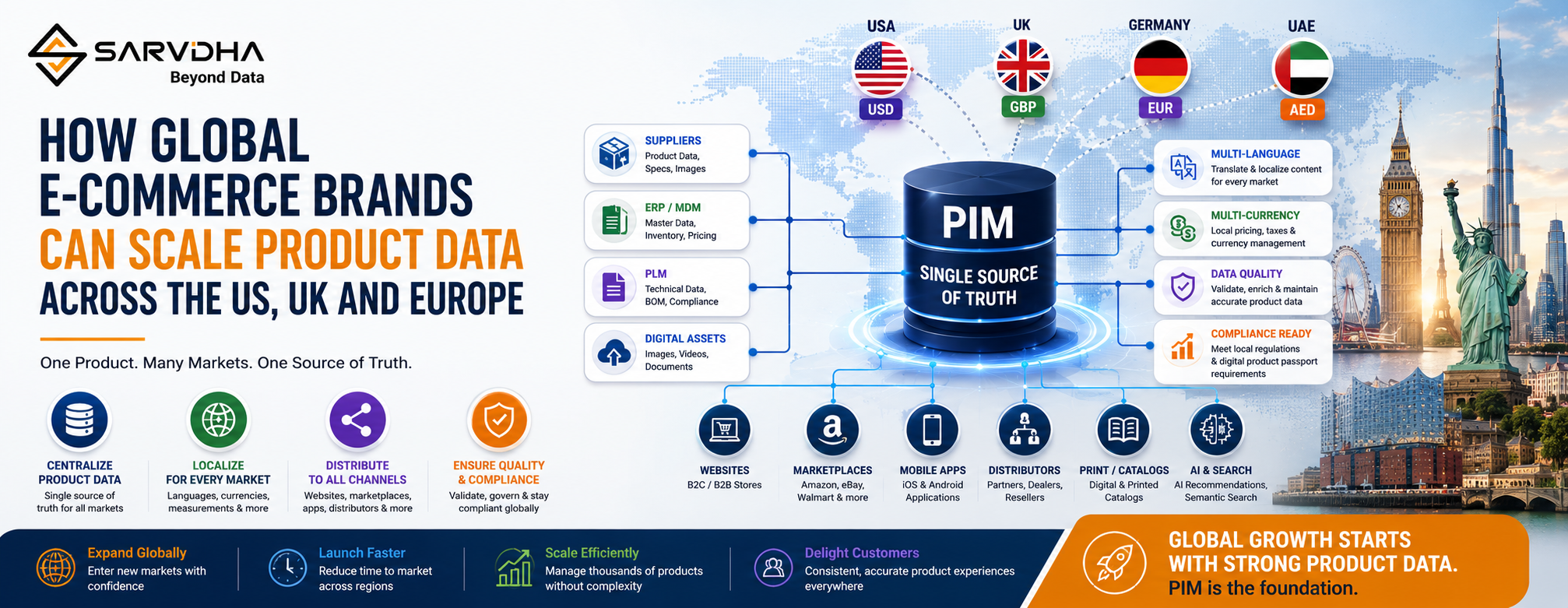
What a Scalable Global Product Data Architecture Looks Like
A mature architecture might look like:
The architecture can vary depending on the business, but the principle remains the same:
Centralize the data foundation and distribute the right information to the right market and channel.
Global Product Data Checklist
Before expanding into another market, businesses should ask:
✓ Do we have a centralized product data model?
✓ Is every product assigned a unique identifier?
✓ Are our product attributes standardized?
✓ Do we have a clear taxonomy?
✓ Can we support multiple languages?
✓ Can we manage multiple currencies?
✓ Can we support market-specific product information?
✓ Can we manage channel-specific requirements?
✓ Do we have a translation workflow?
✓ Do we validate product data before publication?
✓ Can we integrate with marketplaces?
✓ Can we integrate with ERP and other enterprise systems?
✓ Can our product data support AI applications?
✓ Can our architecture support future regulatory requirements?
If several answers are "No", your organization may need to strengthen its product data foundation before scaling internationally.
When Should a Business Consider PIM?
PIM becomes especially valuable when:
- Your product catalog is growing rapidly.
- You operate in multiple countries.
- You sell through multiple channels.
- Product information is managed in spreadsheets.
- Different departments maintain different product data.
- Product launches take too long.
- Customers receive inconsistent product information.
- Your teams spend too much time correcting data.
- You need multilingual product content.
- You are preparing for AI-powered commerce.
- You need better product data governance.
If several of these situations sound familiar, a PIM strategy may be worth evaluating.
PIM, MDM, ERP and DAM: How They Work Together
PIM does not necessarily replace your other enterprise systems.
Instead, these systems can work together.
ERP
Manages operational and transactional information such as inventory, orders, purchasing, and financial processes.
MDM
Manages trusted master data across business entities such as products, customers, suppliers, and locations.
PIM
Focuses on product information used for commerce, marketing, sales, and distribution.
DAM
Manages digital assets such as product images, videos, documents, manuals, and marketing materials.
Together, these systems can create a powerful enterprise data ecosystem.
The Future of Global Product Data
The next generation of e-commerce will require businesses to think beyond traditional product catalogs.
Product data will increasingly support:
- AI search
- Conversational commerce
- Personalized recommendations
- Automated content
- Global localization
- Digital Product Passports
- Product compliance
- Marketplace syndication
- Connected customer experiences
The organizations that build their product data foundation early will be in a stronger position to take advantage of these technologies.
How Sarvdha Helps Businesses Scale Product Data
At Sarvdha, we help businesses design and implement scalable solutions for complex product and enterprise data.
Our expertise includes:
- Product Information Management (PIM)
- Master Data Management (MDM)
- Digital Asset Management (DAM)
- Data Modeling
- Data Integration
- Data Governance
- Enterprise Application Development
- Custom Software Solutions
- AI-ready data foundations
Whether a business is expanding into the US, UK, Europe, UAE, or other international markets, the goal remains the same:
Create trusted product data once, manage it centrally, and deliver the right information to every market and channel.
Conclusion
Global e-commerce creates enormous opportunities for businesses.
But international expansion also creates product data complexity.
The same product may need different languages, currencies, measurements, attributes, descriptions, compliance information, and channel-specific content depending on where and how it is sold.
Managing all of this manually becomes increasingly difficult as a business grows.
A scalable PIM and product data strategy can help businesses create a centralized foundation while still supporting the unique requirements of each market.
And as AI, digital product passports, marketplaces, and personalized commerce continue to evolve, the importance of structured product data will only increase.
The question is no longer:
"How many countries can we sell in?"
The better question is:
"Can our product data scale with our global growth?"
Because global e-commerce doesn't just require more products.
It requires better product data.
Frequently Asked Questions
What is PIM for global e-commerce?
PIM, or Product Information Management, is a centralized approach for managing, enriching, validating, and distributing product information across multiple markets and sales channels.
Why do international businesses need PIM?
International businesses often need to manage multiple languages, currencies, market-specific attributes, product descriptions, compliance information, and sales channels. PIM helps centralize and control this information.
Can PIM manage multiple languages?
Yes. A well-designed PIM solution can support multilingual product names, descriptions, attributes, marketing content, and other localized information.
Can PIM manage multiple countries?
Yes. PIM can be designed to support country- or market-specific product information while maintaining a common core product model.
How does PIM support AI?
PIM can provide AI systems with structured, standardized, validated product information. This can improve AI-powered search, recommendations, content generation, categorization, and conversational commerce.
Is PIM the same as ERP?
No. ERP primarily manages operational and transactional business processes, while PIM focuses on managing product information for commerce, marketing, sales, and distribution. They often work together.
Is PIM useful for marketplaces?
Yes. PIM can help businesses prepare and distribute product information according to different marketplace requirements.
What is Digital Product Passport?
A Digital Product Passport is a digital identity for products that can provide relevant information about areas such as sustainability, circularity, materials, repairability, safety, and compliance, depending on the applicable EU requirements.